

- How Does Dating a Felon or Dating Someone With Trauma or in Recovery Affect Relationships?
- How Does an Unhealed Past Show Up in Relationships?
- How Do You Love Someone With a Bad Past or Relationship Baggage?
- Dealing With Baggage in a Relationship
- Are You Dating in Disguise?
- Frequently Asked Questions About Dating Someone With a Bad Past
- Dating Someone With a Bad Past Doesn't Always Make for a Bad Future
After months of checking profiles, dating someone with a bad past wasn’t top of mind. My search for the next match was — finding that aster in a field of daisies.
One night, I stopped at a profile of a middle-aged man leaning against the open door of a motorcoach, a faded green jacket hanging over his broad shoulders. I swiped right immediately.
The next evening I was chatting with another stranger. Feeling waves of joy, my usual pre-text research took a backseat.
While he was boarding passengers, we texted, sharing interests in cooking and in music. But I was growing tired of typing while ironing.
Soon, his velvet voice filled my ears. “This bus is almost loaded. I’m stopping in Boston, and then New York City tonight.”
“Wow, sounds like a busy night.”
“It’s been 13 years since I was in a relationship,” he said, without an explanation. “Do you ever go through your grocery receipts and find an overcharge or an undercharge?”
“Yes, that happens to me sometimes at Shaw’s.”
“Just last week, I went back to the store after I bought some prime rib because I was undercharged for it. It was only a couple of dollars.”
“You did the right thing. My guilty conscience wouldn’t have let that slip.”
Later, thinking back on the conversation, his admission stood out like a broken taillight.
“I appreciate your ability to hold a conversation, which is rare. What do you like to do for fun?” Beyond the compliment, that question made me swoon. Other men had chattered about themselves.
We made a date for Friday evening at a local coffee shop. After the call, I popped back to his profile, noticing he described himself as a frequent social drinker, which had slipped past my filters.
I Googled his number and found his full name; his profile showed he lived a few towns north. Googling his name led to a newspaper article from 12 years earlier showing a man with darker hair than the one in the profile. As a bookkeeper, he had been convicted of embezzling more than $20,000 from a Baptist church and was given a three-year sentence.
He could have reformed — learned from that mistake, I thought. But taking a chance felt like trying to roll a boulder uphill. I was looking for a safer route.
I asked about the drinking. His answer confirmed my suspicions.
Bringing up his past made me feel queasy. I told him, “I’m not ready to take things further.” I wanted to avoid an argument or an attempt to change my mind. Sometimes protecting yourself matters more than being fully transparent.
I was learning that some asters need more nurturing than I can give.
Discover if You’re an Authentic Dater – Free Quiz
How Does Dating a Felon or Dating Someone With Trauma or in Recovery Affect Relationships?
That experience got me thinking about what dating someone with a bad past really means, and whether you must shoulder their relationship baggage. That “carry on” can include a history of trauma, abuse, substance use, or incarceration.
Is baggage a red flag? Does a partner’s past matter? For some people, the person they love now matters more. But we often judge people based on their past.
If you’ve landed here, you might wonder if someone with such a history is right for you. To help you reach your own conclusions, this blog offers one key question, plus expert advice as a guide. It’s part of a series on assessing if a relationship is right for you.
Relationship baggage spans everything from financial debt to a lack of clear boundaries with an ex. Let’s walk through three serious types of baggage and how each affects a relationship.
1. Trauma or abuse: Trauma refers to abuse or neglect during childhood, including emotional, physical, or sexual abuse and emotional or physical neglect.
People with childhood trauma are more likely to develop depression or anxiety; they also tend to enter relationships that repeat old patterns or be drawn to partners who resemble abusers. This is known as a cycle of abuse.
The U.S. Centers for Disease Control reports that about 64% of U.S. adults have experienced at least one adverse childhood experience, and about one in six (17.3%) had four or more.
Trauma survivors can find it hard to trust. They might also develop insecure attachment patterns, including suppressing their emotions to control them. Other struggles include:
- Hyper-independence: Children whose emotional needs were ignored or neglected can believe they must handle everything alone to survive. As adults, they struggle to ask for help and refuse to express their needs, which blocks intimacy.
- Fear of abandonment or engulfment (or losing oneself): People whose boundaries were severely violated as children often feel smothered by closeness. When a partner tries to connect, their trauma response might be to panic and pull away to stay independent.
- “Splitting”: A defense mechanism where the unhealed person struggles to hold two opposing truths (for example, “This person loves me, but they are also making me mad right now”).
- Going to extremes: They can swing between idealizing a partner, treating them like a savior, and devaluing them (seeing them as cold, uncaring, or “the enemy” over a minor disagreement).
Trauma survivors’ nervous systems often stay on high alert, checking for threats.
An event triggers within them an intense, unexpected, or fear-based reaction: a facial expression, a sound, or a gesture that reminds them of prior danger. Survivors often develop a sense for other people’s expressions and moods to keep themselves safe. They may read neutral moments — a late text, a tired sigh, a quiet mood — as hostility or rejection.
Other common reactions:
- Freezing (stonewalling/dissociation): Pulling away, going numb or silent, or zoning out during conflict because their brain has shut down as a form of protection.
- Fawning (people-pleasing): focusing on keeping the peace and sacrificing their needs to avoid conflict or rejection.
When a person relies almost exclusively on their romantic partner for all their emotional and social support needs, this raises red flags about the health of that relationship.
People who have been impacted by traumatic events or who have struggled with substance abuse will typically experience better results in terms of long-term healing when they are supported by many people such as peers, therapists, family members, and friends.
The moment that a new romantic partner replaces all other support systems can create an imbalance which places significant stress on each member of the couple.”
One study found that childhood trauma led to lower romantic relationship satisfaction through attachment difficulties.
The findings suggest that improving attachment styles and strengthening social support can ease the effects of childhood trauma on relationships. People who experienced neglect were more likely to downplay hard experiences or to see them more positively when they felt supported by a partner.
Trauma can affect relationships when defensive behaviors used in the past for protection are no longer serving your current needs.
One of the biggest concerns is when an individual constantly interprets neutral events as being rejected, betrayed, or abandoned, and expects their partner to help alleviate those fears and be responsible for helping them process these feelings rather than processing them together.
The issue is not simply having trauma, but whether there has been sufficient progress in healing from this trauma so that it does not continue to drive how you respond in your current situation and relationships.”
2. Addiction Recovery: Dating someone in recovery might mean changing parts of your lives over the long term. For instance, you could keep a “dry” household or limit behaviors at social events. Dating someone in recovery puts an ongoing tax on the other partner’s nervous system.
- The Concept: The constant fear the partner will use again.
- The Impact: The non-recovering partner can check for changes in mood, phone habits, lateness, or bank accounts, keeping them in a state of constant anxiety.
Relapse rates for substance use disorders are 40% to 60%. The highest risk occurs in the first 12 weeks post-treatment. Because the brain is short on dopamine early in recovery, people often substitute chemical dependencies with the intense highs of new romance.
~ The National Institute for Drug Abuse
It’s comparable to chronic physical illnesses like hypertension or asthma (which have 50-70% relapse rates).
✅ Sidelining the Relationship: In recovery programs like Alcoholics Anonymous or Narcotics Anonymous, sobriety must come first.
- The Concept: The necessity of the partner’s recovery plan.
- The Impact: The relationship often takes a backseat. The non-recovering partner must accept that meetings, therapy, and sober support networks can override plans. This could leave them to feel neglected or jealous of the recovery community.
✅ The “Sober Caretaker” Identity Crisis: If the relationship started during the addiction, recovery changes each partner’s roles.
- The Concept: A shift from enabler or caretaker to equal partner.
- The Impact: The sober partner’s identity might have been built around managing or protecting the recovering partner. When the recovering partner becomes healthy and self-sufficient, the sober one can feel “unneeded” or struggle to relinquish control over their partner’s life.
3. A Criminal Conviction: When you date someone with a criminal record, you don’t just support them. You inherit their stigma.
- The Impact: The non-convicted partner can shoulder the burden of “the secret,” constantly deciding who to tell (parents, friends, coworkers) and when. If the past is revealed, the non-convicted partner faces judgment, isolation, or blame.
Over 70 million Americans, nearly one in five, have a criminal record.
✅ The “Third Wheel” in the Relationship:
- The Impact: A parole or probation officer can legally make unannounced visits and search shared living spaces, which strips the non-convicted partner of their privacy. Also, there’s a constant fear of a “tripwire.” Because minor infractions or misunderstandings can trigger a violation, the couple faces pressure to suppress conflict or arguments, worried that a police report could send the convicted partner back to jail.
✅ Breadwinner Strain: the employment struggles behind having a record.
- The Impact: Background checks can limit career advancement for life, leading to layoffs or underemployment. This often forces the non-convicted partner into the role of the primary breadwinner. Over time, that imbalance could breed resentment, as one partner feels they’re carrying the financial survival of the household alone.
- Employment gaps from prison or rehab complicate qualifying for a joint mortgage. Some with a past are often self-employed.
- Finding a landlord willing to rent to a felon can be difficult. Even with perfect credit and a clean record since, having their name on the lease could get an application rejected.
A Brennan Center study found that even a misdemeanor conviction reduces a person’s lifetime earning power by an average of 16% (nearly $100,000 in overall wages).
✅ Milestone Blockages: A criminal record can stand in the way of what the couple wants to achieve.
- Depending on the offense, they could be legally barred from fostering or adopting children. The partner with a past might also be barred from volunteering at their children’s school, attending field trips, or living in certain school districts.
✅ Travel: You might never be able to vacation together in countries like Canada or Japan, which have strict “criminal inadmissibility” laws (even for airport layovers or cruise stops).
How Does an Unhealed Past Show Up in Relationships?
If a partner cannot talk about their history without either shutting down or spiraling into anger, blame, or minimizing, that unhealed material will show up in the relationship, usually under stress.
Old trauma or addiction does not vanish. It gets re-triggered by intimacy, dependence, and conflict.
Another hidden flag: someone who is very sure they are “over it” and refuses to touch the topic at all. Healing tends to sound humble and specific. Untreated pain tends to sound performed or defensive. The healthiest early sign of promise: they know what set them off in the past, they can name their own patterns, and they have concrete tools or support they use when things get hard.”
Trauma
When intense thoughts or feelings from trauma resurface, a person might not realize how those reactions affect their ability to trust or heal in relationships, especially if they keep choosing similar partners or landing in similar situations.
The trauma survivor can avoid activities tied to the trauma or discussing topics surrounding it for fear they’ll relive the experience. “A lack of interest in activities — even ones you used to enjoy — is a common symptom of posttraumatic stress and might lead to conflict with your partner. Low interest is especially pronounced if you’re also depressed, which is common after trauma.” (Psychology Today)
- The One-Way Mirror: When someone is stuck in an unhealed survival loop, their emotional energy goes toward managing their threats and triggers.
- The reality: Your bad days, stress, or needs rarely have room because their unhealed trauma stays center stage. If you try to share that you’re struggling, they steer the conversation back to their pain.
2. The Slow-Burn Retaliation: Long-term, passive-aggressive behavior used to regain control.
- The reality: This appears as withholding affection, the silent treatment, or withdrawing emotionally for days to “punish” you or protect themselves after a conflict.
3. Treating Your Boundaries as Abandonment: Insecure attachment shows here as a struggle with healthy boundaries.
- The reality: When you set a boundary like needing an evening alone or wanting to go out with friends, an unhealed partner can misinterpret it as a threat: a sign you’re pulling away or proof you don’t love them.
I would look at how a person handles typical everyday stress and disagreements. If they continue to overreact emotionally when experiencing conflict, tend to place blame on others, avoid situations which could cause potential disagreements, or do not appear to reflect on their actions afterward, this behavior is likely an indication of unresolved psychological issues.
A person’s current ability to regulate their emotions and practice self-awareness is a bigger predictor of how they will act in a relationship than their past trauma.”
Addiction
1. “Dry” vs. Emotional Sobriety: Many people assume that if a partner is no longer addicted, the problem is solved. The difference between these states:
- No longer using isn’t the same as emotional recovery.
- If a partner hasn’t done the inner work (sometimes called being a “dry drunk” in recovery circles), the underlying issues remain. They may still struggle with mood swings, dishonesty, blame-shifting, or emotional distance even while they’re sober.
2. Substitute Addiction: Early in recovery, the brain craves the dopamine spikes it once got from addiction.
- The Concept: Trading one compulsion for another, like replacing a dependency on alcohol with relationship dependency.
- The Impact: The recovering partner might latch onto the new relationship, obsessed with filling the void. Though this feels intense at first, it creates a codependent dynamic. The relationship carries the weight of their sobriety.
An initial indicator may be if an individual is unable to discuss their past issues with abuse or addiction with you at all. When asked about these topics, they may become extremely quiet, withdrawn, or claim that their past traumas have no effect on their current relationships.
Healing from one’s past does not necessarily mean that they have to disclose everything, but it does mean recognizing how your past struggles influence your ability to communicate openly, how you approach conflict, and how you build trust within your relationships.
Individuals with a difficult past can still be in a healthy relationship, especially if both individuals intentionally build their partnership based on accountability and openness.”
Conviction
1. Bringing Prison Home: If they’re unhealed after a long sentence, the home can feel like a cell block.
How it shows up:
- Shutting down emotionally (since showing vulnerability in prison can be dangerous, staying flat becomes a habit)
- Being overly watchful about their space or belongings
- Refusing to let their guard down
- Resisting changes to their routine
2. Hypersensitivity to Being Judged: When someone carries shame about their criminal record, they often project it onto their partner.
How it shows up: They read any normal boundary, question, or disagreement as their partner “acting like a cop,” “putting them on trial,” or “treating them like a criminal.” Because they haven’t made peace with their past, they see your concerns as holding their record over their head.
3. The Paranoia Loop: People who have been through the legal system or have lived a lifestyle that led to a conviction often develop deep-seated paranoia about authority and being caught.
How it shows up: Even if they’ve gone straight, they might hide minor, everyday things like who they were texting or how they spent twenty dollars. This secrecy triggers suspicion, which then triggers the partner to play detective, creating a cycle of distrust.
4. Resistance to Rules: An unhealed criminal past often leaves someone with unresolved anger toward authority figures (police, judges, the system).
How it shows up: They can view their partner’s requests, rules, or boundaries as an attempt to control or dominate them. They react to compromises with defiance, rebellion, or anger.
One of the most telling signs of someone’s potential to be unreliable in a relationship is their tendency to claim they want things to improve but rarely (if ever) doing anything to follow through with those improvements.
I would look at whether they have been actively recovering from issues such as substance abuse, prison time, trauma etc. Are they in treatment, attending AA/NA meetings, or establishing and maintaining healthy routines or habits? If so, what kind of systems do they have in place to hold them accountable for making progress?
The ability to develop long-term sustainable relationships has much less to do with what someone says when you’re having a hard conversation and much more to do with how that person behaves on a regular basis.”
How Do You Love Someone With a Bad Past or Relationship Baggage?
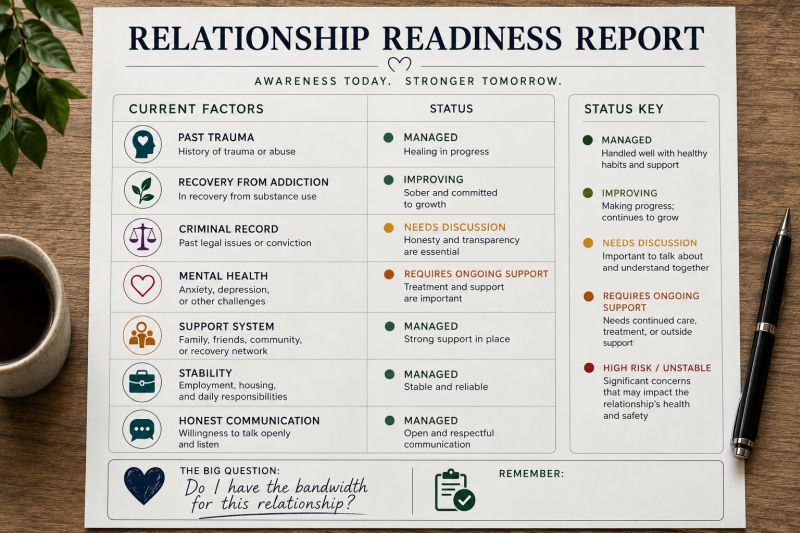
Should a partner’s past matter? Has the past “passed”? The issue is whether they’ve done the work to keep that past from ruining the relationship. This question can help you decide:
Is this person defined by their past or have they worked through it?
The urge to “save” someone with relationship baggage is a red flag. If you find yourself drawn to partners with troubled backgrounds or who need “saving,” your codependency could be a problem. Are you using their problems to distract you from facing your own?
Base any judgments on their actions now.
Their past might matter less than whether they’ve grown and learned from it — how it has shaped who they are now. Yes, they could go back to their old ways, healed or not. We all face challenges, whether or not we carry major relationship baggage. Again, it comes down to how we’ve played the hand we were dealt.
One of the clearest early signs is how someone talks about their past, not just whether they mention it. A partner who can describe prior struggles with some reflection — what they learned, what’s different now, what they’re still working on — shows a degree of integration.
One who either over-discloses in a way that feels rehearsed or performative, or who shuts down completely at any mention of it, often hasn’t fully processed it yet; both extremes suggest the story is still being managed rather than understood.
It’s also worth watching how someone responds to small stressors early in the relationship, since minor friction tends to reveal more than big declarations do. Disproportionate reactions to ordinary conflict, difficulty tolerating your independence, or a pattern of relying on you to regulate their emotions can all be previews of how old wounds will resurface under pressure.
Similarly, addiction history is less concerning on its own than the presence or absence of an ongoing support structure: therapy, a program, a sponsor, some form of accountability. Someone who treats recovery as a closed chapter with no active maintenance is often more vulnerable to relapse than someone who’s still visibly doing the work.”
Remember: You Can’t Save Them From Themselves
When a partner has a trauma response, the instinct is to soothe them like a child. Loving them means learning to speak to their adult self, not their wounded child, and waiting for any triggers to pass before discussing boundaries.
1. There’s a difference between a partner who is having a trauma response and one who is using trauma as a shield for accountability.
Examples:
- Healthy: “My anxiety is flaring up because of what happened to me, so I need to step away for a few minutes to calm down.”
- Unhealthy: “I screamed at you because of my PTSD, and if you loved me, you’d be more understanding instead of making me feel guilty.”
2. Some scars never fade. Even after years of therapy or sobriety, there can be a permanent price tag. Decide if you’re willing to pay that “cost of admission” for a long time or for good.
| Weaponized Trauma (Red Flag) | Integrated Trauma Work (Green Flag) |
| Uses past pain as a shield to escape accountability (“I screamed because of my PTSD. You should be more understanding”). | Owns the trigger while protecting the partner (“My past is flaring up right now; I need to step away for ten minutes to cool down”). |
| Demands that the partner shrink their life, friendships, or boundaries to avoid triggering them. | Takes active responsibility for self-soothing and respects the partner’s healthy boundaries. |
| Oscillates between putting you on a pedestal and treating you like the enemy (splitting). | Communicates through discomfort without withdrawing affection as a punitive tool. |
A partner’s past is always part of the relationship they are currently in. In my couples counseling practice, most partners show signs that their past experiences/wounds impact their current relationship, especially when trying to resolve conflict in a healthy way.
However, key warning signs that these issues may remain unhealed are: not taking responsibility/blaming, harsh criticism, high difficulty to self-soothe and speaking from a position of superiority.”
Dealing With Baggage in a Relationship
Trauma-informed therapy is one option, especially when trauma is severe.
Couples therapy, however, isn’t a substitute for individual therapy. The partner with the past needs to do their own work through something like EMDR (eye movement desensitization and reprocessing) or a 12-step program. Couples therapy can be better for managing communication. A partner needs a basic ability to handle their own emotions before couples communication work takes hold.
Are You Dating in Disguise?
Do you hide how you feel about issues like a criminal past, trauma, or addiction recovery if they come up during dates? If you’ve faced these issues, do you hide them to avoid scaring off potential partners?
We wear masks to hide things we think people will judge us for. Dating openly and honestly takes courage and resilience.
Are you up to the challenge?
Frequently Asked Questions About Dating Someone With a Bad Past
Their nervous system has learned to treat intimacy as a potential threat. Because past relationships linked closeness with danger, their healing relies on rebuilding safety, predictability, and independence.
Be a steady, respectful partner — not their therapist, rehabilitator, or savior.
Four common behaviors:
1. Hyper-Vigilance: As mentioned earlier, survivors are often sensitive to sudden shifts in your tone, body language, or expressions. They can misread certain behaviors as hostility or abandonment.
2. Predictability = Peace: Because abuse keeps a person off-balance, consistency brings relief to a survivor. Being open about your plans, moods, and communication helps lower their anxiety.
3. The “Fawn” Response: To stay safe in the past, many survivors have relied on people-pleasing. In your relationship, this may show up as over-apologizing, hiding their true opinions, or walking on eggshells to keep the peace.
4. Fear of Moving Too Fast: Abusers sometimes start with intense “love-bombing.” Because of this, passing standard relationship milestones too quickly can be overwhelming. A slow pace helps build trust.
Resources:
▪️ The American Psychiatric Association’s Overview on Intimate Partner Violence
▪️ Psychology Today on Trauma Bonding
▪️ The National Domestic Violence Hotline
Many addiction treatment clinicians and recovery networks recommend waiting a full year after continuous sobriety before starting a new romantic relationship. A year can feel like a long time, but early sobriety is fragile. Rushing into dating too soon is a common trigger for a relapse.
Three reasons experts urge a “pause”:
1. The Risk of “Substitute Addiction”: A new romance floods the brain with dopamine and oxytocin, lighting up the same reward pathways addiction once activated. In early recovery, it’s easy to swap a dependency for another, using the “high” of a new partner to avoid doing the inner work.
2. A Divided Focus on Finding Yourself: Rebuilding a life takes time and emotional energy. The first year should center on therapy, establishing healthy routines, building support, and figuring out who you are while sober. A new relationship pulls your focus onto someone else’s needs before yours are stable.
3. The Emotional Toll of Dating: Early sobriety leaves your emotions raw as your new coping skills are still forming. The normal stress of dating — a bad first date, a mixed signal, a sudden breakup — can trigger emotional distress, which could lead to self-medicating.
You can’t build a life with someone else until you’ve built a stable life by yourself.
Resources:
▪️ The Recovery Village’s Analysis of Early Recovery Dating
▪️ Olympic Behavioral Health’s Guide to Relationships in Recovery
▪️ The American Addiction Centers’ Guide to Sober Dating
Dating Someone With a Bad Past Key Takeaways
- A bad past doesn’t disqualify someone. What matters more is what they’ve done with it since.
- Relationship baggage comes in different forms — trauma, addiction recovery, a criminal record — and each has different effects.
- Trust your limits, not just theirs. Someone can be changing and still not be right for you.
- Notice the difference between owning a trigger and weaponizing one. “I need a moment” is doing the work. Using the past to dodge accountability isn’t.
- Authenticity isn’t always the safest choice. In some situations, it’s better to protect yourself than be fully transparent. A white lie can be the more honest act.
- You can’t save someone from themselves. If you’re drawn to fixing partners, ask whether their problems are distracting you from your own.
Dating Someone With a Bad Past Doesn’t Always Make for a Bad Future
What they took from that experience, and how they’ve handled it since, can say more about who they are now than the past itself ever could. The same goes for you: how you weigh dating someone with a bad past and what you’re willing to carry. I walked away from my own story wiser about my limits. It really comes down to knowing what you can offer, and being honest with yourself when the answer is not enough.
Disclaimer: This article is for educational purposes only. If you’re experiencing emotional distress or feel unsafe in your relationship, consult a licensed mental health professional.

She invites singles dating after 30 to join her on the journey to love, one that fosters self-acceptance and an awakening to the joys of life. Discover how dating with intent through expert advice and stories grounded in experience can help you find a match.
For more guidance on authenticity in relationships, watch Michelle’s latest YouTube videos
@MyJourneytoLove-y4e.
- How to Overcome Fear of Rejection in Dating (And Stop Overthinking) - October 2, 2026
- How Being Authentic When Dating Helps You Avoid Manipulation - August 28, 2026
- Relationship Baggage: What to Consider When Dating Someone With a Bad Past - July 24, 2026
