

Three weeks after we last saw each other, I jotted in my journal, “I secretly long to hear the sound of his knock…Sometimes, like today, I’m OK with having gone this long — I can rationalize it on the level that I am not so hurt by not seeing him…”
An image of him running off with a woman he met at a diner cycled through my mind.
Maybe I shouldn’t have wanted to talk more than climb into bed. Or I should have shut my mouth about not seeing him often enough. Though I knew his new schedule was demanding, his silence looked like a maneuver for space.
Days later, after we reunited, the head rush I experienced erased those fears — until more weeks passed.
If you’ve ever wondered how to overcome fear of rejection in dating, you’ve probably also spent hours replaying a conversation that lasted minutes.
It took me years to realize my behavior was part of a broader pattern.

During my younger adulthood, I was diagnosed with a low-level form of obsessive-compulsive disorder (OCD). I didn’t need medication, but could continue to manage it by breaking the loop, which acted like a mental reset button.
When I later crushed on men and tried to date, I noticed I sometimes experienced a form of “love” or relationship OCD, ruminating over mistakes I thought I made.
Even if you don’t have OCD, we all doubt ourselves from time to time, especially when we’re dating — and live or die by their opinions.
What if the most exhausting part of dating is the trial we put ourselves on?
This blog explores why we can feel insecure while dating and the cycle of self-doubt it creates. We’ll also go through how to get past this to achieve self-acceptance — even if you don’t fully love yourself.
DISCLAIMER: This blog is for educational purposes only and doesn’t replace professional therapy or treatment for OCD, anxiety disorders, or other conditions.
Why Dating Can Make Us Feel Insecure
At any time during dating, we might develop doubts about ourselves.
They’re more likely to occur with potential partners you’re attracted to. For instance, you replay when you forgot to thank them for liking your new hairstyle or when you interrupted their play-by-play with your opinion. We can wonder if what happened affects our chances at love. We might feel like we’re missing another opportunity to build a lasting connection.
Two core reasons we can feel insecure:
- Uncertainty – If you enjoyed a date, the silence after a follow-up email or text that stretches from hours to days can make you wonder. Are they too busy to reply? Did they get the message? Did I do something wrong?
Without an answer, it’s hard to coast on faith. We often feel more secure when things are certain. Research shows we’re wired to want to reduce uncertainty, particularly when potential loss or threat is involved. We need “cognitive closure” or to find an answer.
But life is filled with not knowing. When we’re stuck in uncertainty, it’s often a sign we’re more focused on the outcome or destination than on the journey.
We tend to concentrate on what’s next rather than living in the moment, let alone the uncomfortable ones. We want to fast-forward past the pain to when things are free and easy. I do.
Enjoying the journey means that you assess what you liked and disliked about the date. Or whether they were really your type. And then move on to the next adventure.
- A need for approval – If you’ve been focused on making a good impression and tie their reactions to your self-worth, you can develop a fear of rejection. You feel anxious about what they’ll think, calculating your every move — and theirs. You’re afraid to feel vulnerable, to express how you really feel.
So, when someone ghosts you or doesn’t “like” that vacation photo, it can come across as disapproval. Their silence can occur for many reasons. Maybe they’re exhausted. Perhaps they’re distracted.
You might go as far as projecting an image to be liked, passing yourself off as the cool beach bum or the professional who never misses a detail. But it takes energy to maintain that persona.
The hard truth: you can’t control what others think, no matter which role you’re playing. Is gaining their approval vital? How do you know if they like or dislike you, anyway?
Studies consistently show we tend to underestimate how much someone likes us, known as “the liking gap.”
A fear of rejection or need to please others can come down to low self-esteem. And in turn, to anxiety. If you follow attachment theory, which ties how we were cared for in our early years to our behaviors in relationships now, of the four main types, you’d be more in the “anxious” category.
When we have a poor self-image, we’re more likely to aim for perfection, emphasizing others’ opinions. Often, the only person we can please is ourselves, which means your view of yourself is the crucial one.
Did I Ruin the Date or Am I Overthinking?
Insecurity then leads us to the next step — a cycle of self-doubt:
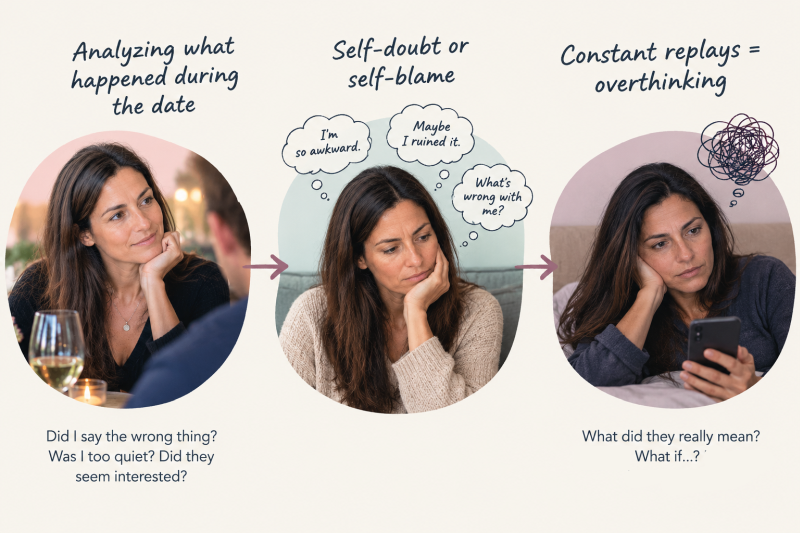
For me, it’s a three-step dance. But if you’re more mindful or aware of your patterns, you might realize you’re overanalyzing at the start.
Even if I know I’m overthinking an incident, it doesn’t stop me from replaying it.
Example: When he said I had “two left feet,” was he joking? What did that mean? Did I do something wrong?
This anxiety doesn’t just plague us after a date. It can affect us throughout.
Before a date, we wonder, “What if I’m awkward, boring, or rejected?” During the date, we check their every reaction, looking for a smile or a frown.
Afterward, if we liked the person and say so, we can read into the response (or lack thereof). If we got mixed signals, the cycle of self-doubt begins and becomes self-sabotage when we seek reassurance or assume they disliked us — even without evidence.
I ask clients to separate the facts from the story: ‘I’m telling myself they didn’t like me’ is a story. Anxiety after a date is your nervous system asking ‘Am I safe?,’ not proof you blew it. Notice it, breathe, and let their actions, not your replay, answer.”
One question to help break the pattern: “Can I trust my interpretation of what happened or is my fear of rejection rewriting the story?”
When a client is replaying a date, I often ask, “Which part of you is doing the ruminating and how old does that part feel?”
We explore what that younger part fears and needs, recognizing that rumination can function as an emotional insurance policy of sorts: if I ‘perfect’ everything that happens, perhaps I can prevent rejection. The aim is to reframe the overthinking with greater compassion and insight rather than run with the anxiety as evidence something went wrong.”
Remember:
- Self-acceptance doesn’t require explaining away inconsistent behavior, disrespect, or lack of reciprocity.
- Don’t convince yourself everything is fine.
- Respond to evidence, not fear, and always treat yourself kindly.
Reflection vs. rumination
- Reflection: “Was I myself? What did I enjoy? Is this person a fit for me?”
- Rumination: “Did I say ‘hi’ wrong? Did I ruin everything? What made them lose interest?”
| Healthy self-reflection | Insecurity-driven self-judgment |
|---|---|
| “I interrupted a few times; next time I’ll slow down.” | “I interrupted, so I am annoying and nobody will want me.” |
| “I felt nervous, but I still showed up.” | “I was nervous, so I failed.” |
| “We might not have clicked.” | “I ruined it.” |
| “I can learn from the date.” | “I need to become a different person before dating again.” |
The Road to Self-Acceptance
We all have awkward moments; self-acceptance is the ability to hold two truths: “I might have made mistakes” and “I’m still worthy of love.”
It doesn’t mean you must love yourself, either.
A reframe I give my clients is that your future partner will one day have to see all sides of you, so one imperfect moment doesn’t mean you did something wrong.
The way they respond to your mistakes can give you insight that saves time and energy, so focus on that instead. And let your anxiety be a sign that you care, instead of proof you messed up.”
Feeling comfortable showing up as you are — as your true, authentic self — means you embrace the occasional stutter or fudged fact. You stop the auditions for their approval, which makes way for someone to get to know the real you. You focus on liking yourself first. And you trust yourself to make the right decisions about who is right for you.
How to Overcome Fear of Rejection in Dating
Before the date:
- Accept that mistakes happen. We’re all human.
During the date:
- Get out of your head: use your senses to experience life around you. Note the color of your date’s eyes. Listen to the flamenco playing in the background. Smell the baked brie fresh from the oven.
After the date:
I encourage clients to separate what happened from what they’re guessing: ‘There was a pause’ is a fact; ‘I made things awkward’ is an interpretation.
Anxiety is a feeling, not proof you did something wrong. Then ask, ‘Did I enjoy their company?’ instead of only, ‘Did they like me?'”
- Forgive yourself for any mistakes.
- If you find yourself replaying awkward parts of the date, name the cycle: “I’m ruminating, not problem-solving.” Remember that OCD-like rumination doesn’t always respond to logic and is sometimes fueled by brain chemicals. So, don’t talk back or criticize yourself for getting stuck. If you have OCD, exposure and response prevention helps you learn to tolerate ambiguity.
- Spend ten minutes journaling how you feel about what happened during the date or seek perspective from a friend you trust. Sometimes, after you express yourself, you feel better.
- Have compassion for yourself. Remind yourself about what you did well and know you were doing your best at the time.
- In her book, “The Gifts of Imperfection,” Brené Brown says that when she feels uncertain, she turns to Reinhold Niebuhr’s Serenity Prayer: “God, grant me the serenity to accept the things I cannot change, the courage to change the things I can, and the wisdom to know the difference.”
- Ask whether you enjoyed the date and whether they suit you.
- Choose one authentic next step without focusing on the outcome, whether to move on or follow up. Resist any urges to sink into self-sabotage by getting jittery over silence or a slow reply. Put the phone in another room or set a rule not to check for texts before bedtime.
Surrender to the moment despite what they think. Release the need to control life according to a script in your head. We have more control over how we respond to what happens.
And if an exercise becomes something you feel compelled to repeat until you feel certain or calm, raise it with a therapist rather than treating it as a rule.
If you still struggle to get out of the spiral of self-doubt or it stops your enjoyment of daily life, talk to a doctor or a mental health provider.
I have clients draw a line down a page and write only what actually happened on the left, and what they felt at the moment on the right. I like to show them the difference between ‘I talked about my job’ beside ‘I bored them.’
When you see them side by side, it gets easier to notice how much of the replay is fabricated by their minds rather than what actually happened. I also ask clients what they’d say to a close friend who described the same evening. They almost always come up with kindness and perspective they haven’t been offering themselves.”
Are You Dating in Disguise?
Overthinking after a date often happens because we spent hours performing.
When you lack confidence, you feel more comfortable showing up as the one who keeps the conversation going rather than accepting the occasional silence. Or you might agree with their choice of restaurant rather than suggesting the new trattoria down the street.
You can feel like you’re stifling yourself to win their approval. And that sparks a cycle of self-doubt, especially after the date ends.
But when you have the courage to tear off the mask, you feel relieved. You’re no longer “faking it until you make it.”
Find out if you’re showing up as yourself on dates.
Self-Acceptance As a Work in Progress
You might not stop feeling nervous about dates or fully end the replays. And that’s OK. (I haven’t.) You can keep learning from those experiences and still have a fulfilling dating life, one in which you accept whatever happens and bounce back from setbacks.
I also haven’t “figured it all out.” I still sometimes struggle to have compassion for myself and my mistakes. But I’ve stopped worrying about how to overcome fear of rejection in dating, realizing I can’t control how someone responds to my “no” or to my “yes.” I don’t always feel comfortable being authentic, but I feel better when I show up as I am.
Authenticity is scary, especially if we’re not used to it. It takes faith. And courage.
Brené Brown suggests that regardless, we must ultimately answer this: “What’s the greater risk? Letting go of what people think, or letting go of how I feel, what I believe, and who I am?”

She invites singles dating after 30 to join her on the journey to love, one that fosters self-acceptance and an awakening to the joys of life. Discover how dating with intent through expert advice and stories grounded in experience can help you find a match.
For more guidance on authenticity in relationships, watch Michelle’s latest YouTube videos
@MyJourneytoLove-y4e.
- How to Overcome Fear of Rejection in Dating (And Stop Overthinking) - October 2, 2026
- How Being Authentic When Dating Helps You Avoid Manipulation - August 28, 2026
- Relationship Baggage: What to Consider When Dating Someone With a Bad Past - July 24, 2026
