

- The Invisible Loop of Relationship Anxiety
- How Past Conditioning Leads to Overthinking in Relationships
- The Science of Overthinking in Relationships
- Two Symptoms: When Protection Looks Like Self-Sabotage in Relationships
- Confusing Hyper-Awareness With Healing
- The Antidote to the Watcher
- Forgetting a Coat: Freezing in Time
- Expert Tools to Break the Relationship Anxiety Loop
- The "Am I Dating in Disguise?" Quiz
- Self-Sabotage in Relationships: 3 Takeaways
- Healing From Self-Sabotage in Relationships
His silence left me wondering why I self-sabotage in relationships.
We met for coffee after messaging on a digital marketing forum. His upvotes and comments like “Your email stats look beautiful” hooked me, and his smiling profile photo helped.
After I learned he was single, I suggested we meet to talk shop. I told myself it was just networking. But I still spent 20 minutes curling my hair and wore the shirt that brings out the green in my eyes — just in case.

Over the next half hour, as he debated open rates, my latte went cold. And I had laughed so hard over his SEO pun I nearly spilled it.
As he leaned in, I asked, “Would you be interested in the results of my next email marketing campaign?”
“Yes, I’d love to see them,” he said, smiling.
I promised to follow up, mapping out how I’d frame them.
But the campaign took longer than I thought. Despite several A/B tests, my tests and tweaks underperformed — and I took it personally.
As time dragged on, I compared his reply on Tuesday at 10:47 am with the 18-hour gap on Thursday. When I typed the follow-up, I cut the line about having a crush on him, then softened my compliments about his marketing insights to show less interest.
I wrote two versions, each spinning the results favorably. But the phrasing still felt off. Weeks later, the email I sent highlighted the lessons I learned and thanked him for his interest. Afterward, I refreshed my inbox regularly for days, only for the message I sent to stare back at me.
The silence gave me time to spot a familiar pattern.
I knew the signs: overthinking his response times, cutting anything vulnerable, convincing myself “professional boundaries” justified my hesitation. I’d studied past connections and knew what went wrong — yet still repeated the same self-sabotage in relationships.
Why doesn’t awareness change behavior? Why do we shift from “open and connected” to “closed off and calculating”?
Many of us face this disconnect — despite knowing better, we do the same thing, like running the same failed email campaign.
Psychologists believe these reactions often stem from deeply rooted survival responses. “Cold feet” are a biological safety mechanism.
And the numbers aren’t nice. A 2024 study found couples often split once their relationship satisfaction falls to about 65 percent. Chronic withdrawal — like the silence I gave him — can sink a relationship before it starts.
The Invisible Loop of Relationship Anxiety
I call this pattern the Invisible Loop: the paradox of wanting to connect but pulling away when vulnerability surfaces.
| Stage | What’s Happening | Internal Narrative |
| 1. Hyper-Arousal | Anxiety & Panic | “I need to fix this/chase them.” |
| 2. Intellectualization | The “Watcher” | “Maybe it’s not a match? Let me analyze.” |
| 3. Hypo-Arousal | The Freeze | “I feel nothing. I’m bored/numb.” |
| 4. The Gap | Regret & Shame | “Why did I pull away again?” |
In attachment theory, this is often linked to an anxious avoidant attachment style (sometimes called fearful avoidant or disorganized). When your nervous system gets confused, the push-pull dynamic works like this:
- The Pull Back (Hypoarousal): When things feel too real, you hit a “functional freeze.” You go emotionally numb or ghost them.
- The Push Forward (Hyperarousal): Once the threat of intimacy eases, panic sets in. You regret the silence. You chase them — for now.
Surveys estimate five to ten percent of American adults have an anxious avoidant attachment style. But the number could be as much as 25 percent of those who report relationship anxiety or struggles.
Why do we get stuck here?
Like my last blog, this one explores the themes of three questions from the “Am I Dating in Disguise”? Quiz. Below, we’ll dig into what causes this loop and how to stop self-sabotage in relationships.
How Past Conditioning Leads to Overthinking in Relationships
Past traumatic experiences can trigger sudden or involuntary reactions now. So, when you suppress your feelings from the person across from you at the coffee shop, your nervous system isn’t necessarily reacting to them. It’s reacting to the history behind what they represent.
The core issue? Your system learned that vulnerability = danger.
This conditioning can come from anything that overwhelmed your ability to cope, including:
- Major trauma: Physical or emotional abuse, abandonment, or serious accidents. (Waking the Tiger: Healing Trauma by Peter A. Levine with Ann Frederick.)
- Attachment or relationship trauma: Inconsistent parenting, withdrawal of love, constant criticism, or severe infidelity.
- Subtle trauma: Common, but often downplayed experiences like chronic invalidation, being mocked when vulnerable, or comforting yourself often without support.
Why does this happen?
The Subconscious Safety Scanner
Your body uses a “subconscious safety-scanner” called neuroception. It checks for threats before you’re aware of them.
Example: If an ex-lover once rejected you, your scanner flags interest from a new date and flags as a potential threat. In response, it triggers protective behaviors like game-playing or emotional distance.
As Dr. Peter A. Levine notes in Waking the Tiger, trauma isn’t in the event; it’s energy stored in the body.
The Biological Impact
This isn’t just a software issue; it’s a hardware issue. Trauma can change your brain’s structure.
Neuroimaging studies show adults with histories of severe childhood abuse or maltreatment often have a smaller hippocampus — the brain’s control center for memory and stress — than non-traumatized adults. In some studies, the volume reduction ranged from 12 to 18 percent.
When the hippocampus is smaller, it struggles to distinguish between “then” (the past trauma) and “now” (a coffee date). As a result, your nervous system stays tuned to sense danger even when you’re safe.
The Science of Overthinking in Relationships
1.The Hierarchy of Safety: Polyvagal Theory, developed by Dr. Stephen Porges, explains that our nervous system follows a hierarchy of responses. Though some neuroscientists debate the theory’s finer bodily details, it offers a map for understanding how fear takes over.
When you perceive a threat, your body doesn’t just feel “scared.” It physically shifts gears.
- Safety: You’re social and connected.
- Mobilization (fight/flight): You feel anxious, alert, and ready to run.
- Immobilization (freeze/dorsal vagal): This is the emotional “emergency brake.” When danger feels overwhelming — even from faint memories or subtle cues — your system shuts down. Your heart rate slows, your thoughts narrow, and you go emotionally blank, like a deer in the headlights.
2. The Window of Tolerance: Researchers call the zone where we function best the “Window of Tolerance.” Here’s how that looks through the lens of dating:
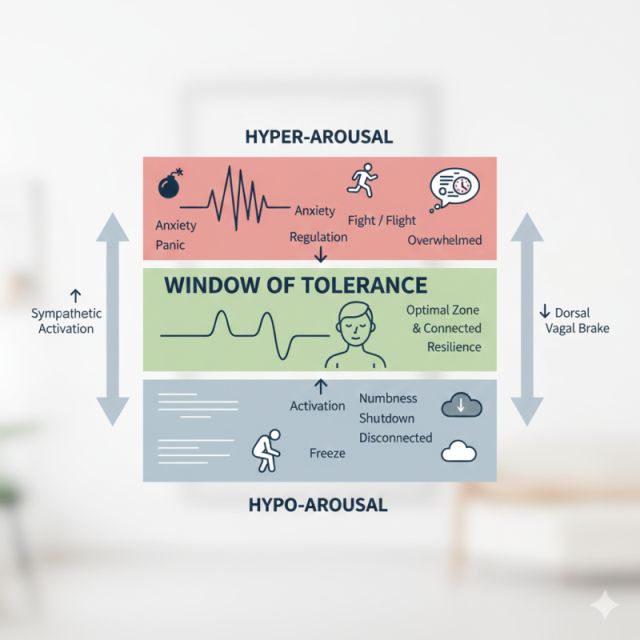
- The Window: You’re present, open, and able to connect on the date.
- Hyperarousal (going up): You fly above the window into relationship anxiety. You over-analyze texts, play games, or feel the urge to flee.
- Hypoarousal (going down): You drop below the window into numbness. You feel “checked out” or decide there’s “no spark.” Clinicians estimate roughly one in seven people with PTSD experience this “shutdown” response; in trauma-exposed groups, it’s closer to one in three.
Even without a diagnosis, chronic stress can push anyone outside their window of comfort.
3. The “Bottom-Up” Hijack: Have you ever wondered why you can’t just talk yourself out of anxiety?
It’s because trauma responses work “bottom-up” (body → brain), while logic flows “top-down” (brain → body).
When your amygdala (the brain’s threat detector) views vulnerability as danger, it reacts in milliseconds. Your conscious, logical brain (the prefrontal cortex) takes a few more seconds longer to catch up.
By the time you think, “I should just reply to her text,” your body has already pulled the emergency brake. You aren’t holding back on purpose; your system is temporarily “offline.”
The Fix: Name It to Tame It: According to Dr. Dan Siegel, the first step isn’t to analyze the story (which re-triggers the fear). It’s to name the feeling in the body. Describing sensations like “my chest is tight” or “my stomach is dropping” helps calm the amygdala and brings the thinking brain back online.
Healing Can’t Be Done Alone
We don’t just heal so we can be in relationships; we heal through relationships.
- When we form close bonds, our bodies start to regulate each other: studies show a partner can affect our blood pressure, heart rate, and hormonal levels.
- In practice, this means a calm, safe partner can help pull you out of a trauma response faster than you could alone. The takeaway? Healing isn’t a solo endeavor. A nurturing partnership can retrain your neuroception to trust safety, widening your window of tolerance.
“Dependency is a fact, not a choice or a preference. It is literally part of our genetic and biological makeup to pair up.”
~ Amir Levine
Your self-sabotaging pause is an automatic protective response.
Neuroception explains how these reactions are wired in your nervous system as survival mechanisms to keep you safe — not because of any “bad relationship baggage.”
Two Symptoms: When Protection Looks Like Self-Sabotage in Relationships
Though you might not always notice your behavior, the effects can still surprise you, which explains why “knowing” doesn’t always lead to “doing.” These patterns can sabotage your intentions in dating.
1. The “In My Head” Trap (intellectualization/the insight-behavior gap): you feel disconnected from intimate moments; you’re analyzing rather than feeling, which keeps you guarded to avoid uncomfortable emotions and leads to game-playing that contradicts your interests.
Think of a time you wanted to text him, but froze. What you want to do (be open) and what you do (pull away) can be miles apart. Why?
If you feel like you “know better” but still can’t stop your patterns, science backs you up. Research shows that conscious intention accounts for only about 28 percent of our behavior. Your nervous system and reactions trigger the other 72 percent.
Game-playing or analyzing isn’t bad behavior. It’s a defense mechanism. If you do it, you can retreat to your “safe” mind to avoid “unsafe” feelings in your body. It’s numbness that looks like boredom or a lack of chemistry.
You might walk away from a connection because you think it’s boring, when really your system is frozen because true intimacy feels terrifying.
- Scenario A (not a freeze): You meet someone kind, respectful, and safe, but you feel no desire. True disinterest feels like a clear, conscious “I don’t care. I’d rather be home alone.”
- Scenario B (possible freeze): You meet someone who appeals to you, but as you get closer, you feel numb, dull, or the urge to pull away. You feel like you’re watching yourself from the ceiling. (A felt sense of dissociation.)
Before you dismiss a safe connection because you feel a flatline, ask, “Am I truly uninterested, or is my body trying to protect me from the vulnerability that comes with connection?”
2. The Reflection Paradox: Analysis vs. Action: It’s ironic: reflecting on your patterns, understanding your needs, and analyzing past relationships feels like progress. But it can keep you stuck in your head.
Intellectual insight activates the thinking brain, yet the deeper, survival-oriented nervous system controls automatic behaviors. You can know something but react based on an old program.
When you stay stuck in this invisible loop, the stakes are more physical than emotional. Research shows that being in an unhappy or high-conflict relationship poses a risk to your longevity comparable to obesity or smoking 15 cigarettes a day. Your body perceives the relationship as a life-threatening stressor.
Dr. Bessel van der Kolk believed “You cannot talk yourself out of what your body knows,” which is why thinking often fails.
The loop or paradox is:
- More reflection = more understanding
- But more understanding ≠ more presence, sensuality, or authentic behavior
What starts as an emotional issue turns into avoidance when you analyze rather than feel, leaving you disconnected from your body and your true self.
Confusing Hyper-Awareness With Healing
When we over-analyze why we’re single or why we acted that way, we slip from helpful reflection into rumination, which raises stress and anxiety, making connection harder. This is sometimes known as the “self‑absorption paradox.”
In trauma-informed therapy, this overthinking is called “The Watcher at the Gate.” This “watcher” is the brain’s protective part (the prefrontal cortex) trying too hard to regain control after being knocked offline by a trigger. It mistakes hypervigilance — a trauma response — for genuine self-awareness, a healing skill.
The watcher’s job is to keep you in an analysis loop, shielding you from vulnerable feelings that recall past trauma.
The Watcher in the Anxious-Avoidant Style
The anxious-avoidant attachment style is a perfect example of this loop. The “Watcher at the Gate” can manifest in two ways:
- The Analyst: Anxiety makes them overanalyze everything (rumination/hypervigilance) to feel safe.
- The Detacher: Avoidance leads the person to withdraw into their “safe” mind to dodge the messy feeling of connection, which triggers fight-or-flight behavior — the push-pull dynamic.
This pattern explains why the neuroception-driven freeze can look like “losing interest” and why the panic that follows resembles “chasing.” They might want, yet fear, intimacy. (Attachment styles describe tendencies, not clinical diagnoses.)
The Antidote to the Watcher
Dr. Susan Nolen-Hoeksema’s research shows that overanalyzing problems often leads to increased depression and anxiety, not solutions. The antidote is radical acceptance.
“When we stop analyzing ourselves through the lens of past criticism and instead stand still in the presence of our own truth, we create the conditions for real transformation.”
Dr. Larry Mark Honig
Self-compassion is also a biological necessity. Dr. Kristin Neff notes that being kinder to yourself activates your brain’s internal caregiving system through oxytocin (the bonding hormone).
This counteracts stress hormones, signaling safety to the nervous system. Taking a self-compassion break can stop the reflection paradox loop.
In a brief self‑compassion intervention, students’ self-compassion scores rose 43 percent, with major reductions in depression, anxiety, stress, and emotional avoidance.
The key to stopping the “self-sabotage” loop isn’t more analysis — it’s resetting the body’s internal safety setting.
Forgetting a Coat: Freezing in Time
Though some of it could have been due to pre-date nerves, the time I forgot my coat before a date arrived illustrates these concepts.
In that story, I moved from tense alertness to quietly shutting down. Let’s walk through the progression:
- Hyperarousal (The Warm-up): My anxious “dress rehearsal” put my nervous system on alert, scanning for risks — the fight/flight state.
- The Trigger (The Chill): Stepping out into the cold and the silent tension triggered a sense of danger in me. My fear of being “found out” was even greater. My nervous system switched to a shutdown response (functional freeze): I opted for survival over comfort.
- Functional Freeze (The Shutdown): My lack of attention (or disassociation) when I was primping, my suppression of the urge to get my coat, and submission to the situation were other signs of emotional numbness to protect myself.
Also, when I stayed silent, I experienced an insight → action gap: I knew what to do, but my nervous system overrode my intention.
In polyvagal terms, my body sensed danger before my mind, pulling me out of my window of tolerance and into a freeze that blocked my usual responses. (Low self-esteem also likely played a role.)
Chronic inaction like this is a common sign of trauma.
Expert Tools to Break the Relationship Anxiety Loop
My on-the-spot anchor is a simple mantra: “I honor this moment as a gift to restore my mind, body, and spirit.” Silently repeating it interrupts the mental spiral and brings attention back to the present, making it easier to stay open.
See if you can remain non-judgmental or neutral when you tend to be self-critical. If you’re stuck in your head, focus on a key “goal” and turn it into a phrase/mantra — like “Be yourself” or “Slow down.”
When you feel yourself slipping into your head on a date, the fastest reset I teach clients is to anchor into the body. Press your feet into the floor, drop your shoulders, and take one slow exhale.
This signals safety to the nervous system and interrupts the freeze-or-overthink spiral instantly. Once the body feels safe, the real you can emerge again.
When you feel yourself freezing, overthinking, or slipping into old patterns, the quickest reset is to count backward from five to one to re-engage your prefrontal cortex and interrupt the fear response.
Then take one slow breath and name the sensation as excitement instead of nervousness. This simple shift brings you out of protection mode and back into presence to connect authentically.
We encourage using a simple grounding anchor to stay present in high-stress or overthinking moments.
One effective micro-practice is focusing on slow, deliberate breathing while silently naming five things in your environment: what you see, hear, or feel. This interrupts the autopilot response, calms the nervous system, and allows patients or clients to engage fully and mindfully in the moment.
The simplest anchor we teach is a micro-breathing reset: inhale slowly for four counts, pause for four, exhale for six.
This signals to the nervous system that the moment is safe, giving the mind a chance to shift from hyper-analysis to presence. Pairing the breath with noticing one sensory detail in the environment like the texture of the table or a sound nearby interrupts the freeze, allowing authentic connection to emerge naturally.
When you feel yourself drifting into analysis or autopilot, pause for a moment and remind yourself why you’re there: to get to know the person across from you and to let them learn more about you.
That brief intentional redirect can help you focus more on building authentic connection and less on performance.
When your nervous system remembers why you’re there, your presence can more easily follow suit. Who knows? You might actually be able to enjoy yourself!
I’m a big fan of using anchor phrases to help a person stay present and show up the way they want to on a date — especially when it feels like the nervous system could hijack the experience!
Have a phrase like “he/she’s just a person” and “I am choosing to be present” or my favorite “I’m collecting data (to see if we’re a good fit)” prepared to recite in your head when you feel those autopilot feelings start.
Also, take a slow, intentional breath and pause before talking to interrupt the fight-or-flight response.
When my clients are concerned about getting stuck in their heads, we have usually already done the work to ascertain why being vulnerable causes these reactions.
To diffuse the trigger, one common tool I use is to simplify where they are in that moment. Usually, this will be a reminder that this is just a date, a “getting to know someone” experience. There is no pressure for this to be anything or for you or them to prove anything. Then add some self-soothing talk such as “This is OK and I am OK.” I ask them to repeat this before the date.
The “Am I Dating in Disguise?” Quiz
Stop attracting the wrong partners — those who like the act, not the real you. Take charge of your dating life. When you stop pretending, you’ll feel more present — free from the fear and anxiety that fuel overthinking.
When you reach your essence or true self, you feel more like yourself.
Take the dating quiz, get your answers, and find out. The middle three questions cover the three themes discussed in this blog.
Healing From Self-Sabotage in Relationships
Being honest with yourself and with others is the core of authentic dating. When you suppress your feelings or feel disconnected, it’s a sign your nervous system’s protective “Watcher at the Gate” is active, creating inauthenticity.
But you can heal while you’re dating. One way is through self-compassion, your body’s signal that your nervous system should quiet the watcher and open your window of tolerance — and release your true self. When trauma responses no longer control your behavior, you stop attracting partners who like the act, not the real you.
The advice in this blog is no substitute for a professional diagnosis. If you can’t break the pattern of self-sabotage in relationships and need guidance (especially for processing trauma), seek help from a licensed mental health provider.
Wondering if you’re dating in disguise? Find out if you’re showing up as you are today.

She invites singles dating after 30 to join her on the journey to love, one that fosters self-acceptance and an awakening to the joys of life. Discover how dating with intent through expert advice and stories grounded in experience can help you find a match.
For more guidance on authenticity in relationships, watch Michelle’s latest YouTube videos
@MyJourneytoLove-y4e.
- Relationship Doubts: Is This Relationship Right for Me? A Fixed vs. Fluid View - March 25, 2026
- Truecasting 101: Stop Losing Yourself and Begin Building Authentic Relationships - February 18, 2026
- How Dating App Fatigue Kills Authenticity in Relationships — and How Clear-Coding Fixes It - January 23, 2026
