

- How Do I Tell if Someone Likes Me for Who I Am or for the Persona I’m Presenting?
- Am I Hiding My True Self or Simply Adapting to Make a Good Impression?
- The Blocks to Being Authentic When Dating
- 4 Signs You're Not Truecasting, You're Auditioning
- Building Authentic Relationships Slowly
- Truecasting: From Performance to Romance
- The Inner Work Behind Truecasting
- Self-Acceptance: A Dating Superpower
- How Do I Reveal Layers Without My Vulnerabilities Being Weaponized Later?
- Expert Takes: Being Authentic When Dating
- When is Regularly Evaluating Who I’m Dating a Healthy Filter Versus Self-Erasure?
- The Key to Building Authentic Relationships
Building authentic relationships is the goal — or so I told myself as I pulled on the shapely lavender spandex v-neck and thigh-hugging black leggings. When he passed by me, he stopped to laugh and lean in.

The rush from his attention felt like a “win.” When his text popped onscreen a few hours after my dinner — “When you said no one was helping, I wanted to give you a hug” — I saw it as a green light. As I started mapping out our first real date, I stuffed my replies full of emojis.
But when I shared what scared me, he’d turn the spotlight back onto himself. Later, when I asked him how he felt about me, his answer splashed like ice water: “I see you as a plaything.”
He noticed — but not the parts I wanted him to focus on.
The TL;DR: Drop the Mask, Skip the Missteps
Presenting a polished persona might land you dates, but not lasting love. Read on to learn:
- How attachment styles shape how we mask
- Why hiding quirks can backfire
- How self-acceptance and truecasting help in building authentic relationships
The payoff: fewer false starts and more being authentic when dating based on who you are — not a performance.
How Do I Tell if Someone Likes Me for Who I Am or for the Persona I’m Presenting?
The desire to shield ourselves is normal, often to avoid the pain of rejection. Despite the urge to present a polished self, true connection needs some honesty; we don’t really know someone until we know their pleasures and their pains.
To drop the mask, ask: Do I choose to be liked or do I choose to be known? Your willingness to follow through depends on your level of bravery.
Am I Hiding My True Self or Simply Adapting to Make a Good Impression?
Psychologist Erving Goffman wrote that people “deliberately construct their behavior” to make positive impressions, known as impression management; Goffman’s “Presentation of Self” theory reminds us we’re all actors who want to pass the audition.
For example, a study of online daters found people constantly balance crafting a perfect profile with wanting to be real. The result is often “contrived authenticity”: a carefully edited persona that feels real to others but hides our imperfections.
We fall back on this because intimacy requires vulnerability: we fear showing our unguarded feelings or flaws. Yet researchers emphasize that honesty and self-disclosure are key to feeling understood in a relationship.
Eight in ten U.K. singles view edited, filtered, and curated dating photos as a turn-off. By contrast, authentic images have been found to boost profile “likes” and messages received.
~ GlobalDatingInsights.com
The Blocks to Being Authentic When Dating
Butterflies often trigger fawn-like shapeshifting. When we’re jittery, to calm down, people-pleasing can feel safer — fueled by the dopamine rush from early “wins.”
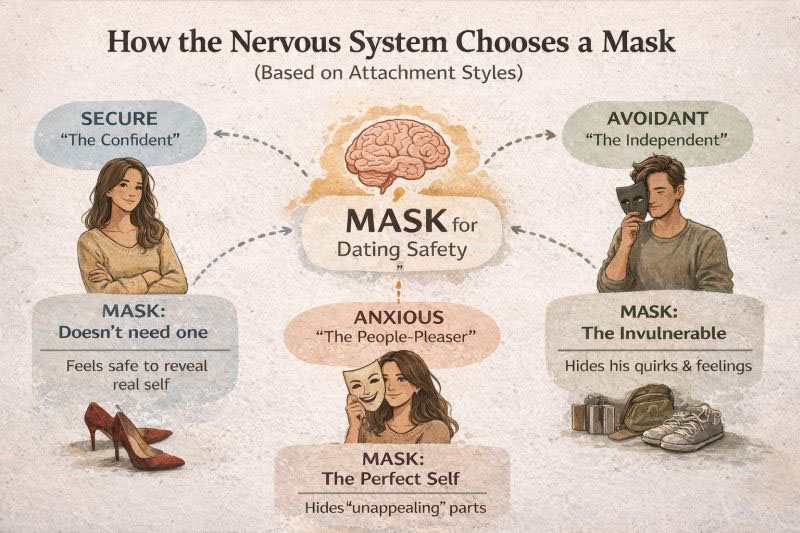
Attachment Styles and Theory: The Blueprint for “Dating in Disguise”
Our attachment history – how we related to caregivers – influences our dating behaviors. Attachment theory holds that people form beliefs and expectations based on early bonds. They later govern how we behave in romantic relationships.
Securely attached daters trust that their real self is enough, yet insecure styles shield as a survival strategy:
- Anxious (The People-Pleaser): A negative self-view and a fear of abandonment cause you to project the persona you think they want. You hide your needs, which can lead to a “vulnerability hangover” when you speak up.
- Avoidant (The Independent): Fueled by a distrust of support, you shroud your feelings and hobbies. If they can’t see the real you, they can’t hurt the real you.
Spotting these patterns helps you learn when your nervous system is “masking” to protect you. Truecasting, being authentic when dating or honest from the start, acts as the “manual override” for defense mechanisms. It lets you test for safety rather than assuming rejection will happen.
4 Signs You’re Not Truecasting, You’re Auditioning
Some hints you’re not being authentic when dating:
- The Audition: If you find yourself rehearsing stories, choosing outfits for “effect” (like my tight clothes story), or curating your social media profile for perfection, you’re performing, not making an effort to connect.
- The Hobby Filter: Are you hiding your quirks, like omitting a love of World of Warcraft from your profile? Suppressing your “geeky” side contrives authenticity that eventually feels like a lie.
According to a 2024 Zoosk study, 54 percent of singles age 30-55 report hiding personality traits or hobbies early in dating to avoid rejection, leading to mismatched connections later.
- Playing It Cool: Do you withhold your desire for security because you don’t want to seem “needy”? As a study found, the fear of “friendly rejection” leads many to conceal their genuine feelings, which increases anxiety instead of protecting you. Yet psychologists advise that true vulnerability is the gateway to building authentic relationships.
48 percent of daters hide or “soften” information about their mental health struggles while they date.
- The “Inner Work” Wrestling Match: Are you so focused on spotting red flags that you’ve built a barrier to vulnerability? If so, your self-awareness has become another performance — for yourself. Sometimes overanalysis masks fear.
A healthier option: Notice when you’re narrating the date like a case study. Ask yourself: “Am I using psychology to understand this person or to avoid risking my emotions?” True inner work involves sitting with uncertainty, not creating certainty through making an armchair diagnosis.
Example:
- Red flag: “He mentioned his ex twice — classic avoidant dismissing behavior.”
- Green flag: “He mentioned his ex. How do I feel about that? Curious? Uncomfortable? What does my reaction tell me about what I need?”
Building Authentic Relationships Slowly
Should you practice being authentic when dating from the start? Tinder’s Year-in-Swipe Report revealed that one in four daters practice truecasting, which removes the guesswork early.
There’s a difference between truecasting and trauma dumping. Truecasting asks you to be honest, but you’re not necessarily discussing an abusive relationship right away.
A “hot take” on truecasting: Total authenticity from day one can be unrealistic and counterproductive; measured or paced inauthenticity protects against early rejection.
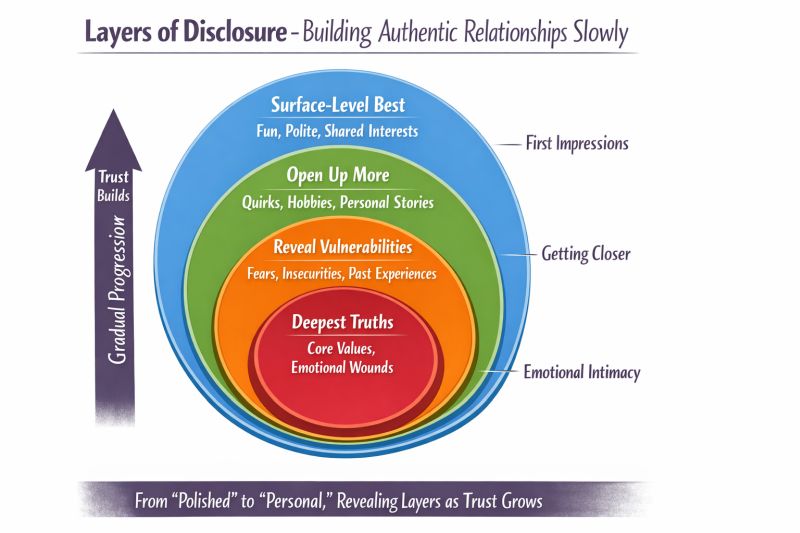
The thinking is that you should present your “surface-level best”: strategically curate or “dial down” your quirks to hold attraction. Then reveal more layers to build trust gradually.
Slow unmasking/phased reveal strategies help you “dip your toes” into being authentic when dating (like sharing one safe quirk, testing reactions before being more vulnerable). For people who have experienced trauma, this can feel safer than diving in.
Truecasting: From Performance to Romance
Think of truecasting as a filtering system. Here’s how to apply it to the most common dating hurdles:
- How do I stop self-silencing without wrecking the date?
The Safe Quirk Test: Share one small, authentic reveal to test their reaction before you “open the vault.”
Example: “Firefly is my favorite TV show. It’s like a western set in space.”
- How do I use truecasting in messages or on a first date?
Be more direct.
Example: I’m looking for a long-term partner. Are we on the same page?
- If I start being more authentic, will I lose matches or scare people off? How do I balance honesty with safety?
The point of truecasting is to filter out mismatches. It can save you time. To balance honesty with safety, you don’t have to “tell all” at the start. You may reveal more later.
Examples:
- First message/early date: “I’m looking for a serious and committed relationship, not a situationship.”
➡️ This filters hookups without disclosing your relationship history or timeline preferences yet. - Date two or three: “I’m a homebody at heart. My perfect Friday evening involves board games and takeout, not bar-hopping.”
➡️ Reveals lifestyle compatibility without listing every introvert trait or past social anxiety. - When trust builds: “I’ve done a lot of therapy around my anxious attachment style, so I need regular reassurance.”
➡️ Shows self-awareness and needs, but only after you’ve tested whether they respect boundaries.
Each layer reveals more while it gives you more peace. If someone bounces at “I want something serious,” they’ve saved you months of mixed signals. If they stay, you’ve found someone worth the risk of revealing your true self.
The Inner Work Behind Truecasting
Self-awareness isn’t just a buzzword or a spiritual concept. Taking stock of your thoughts and history can improve your dating outcomes. Psychologists stress that people who have done this tend to stop reacting and start using their inner compass.
Identify, Then Modify: Research shows that noticing recurring mistakes, like choosing emotionally unavailable partners, is the first step toward change.
The Result: You stop asking “Why does this keep happening?” and start seeing the red flags while they’re still tiny.
The “Same Page” Advantage: People with greater self-insight are more likely to express their needs and boundaries early.
The Result: You move from “playing it cool” to saying, “I need consistent communication,” which sifts out mismatches.
Rejection as Data: Self-reflective daters view “no” as neutral information.
The Result: You build a “rejection-proof” ego. If they dislike the real you, it’s data, not a disaster.
Favoring Compatibility over Chemistry: Thinking things over shifts your focus from “Do they like me?” to “Do they make me feel respected and understood?”
The Result: You stop chasing “butterflies” (which are often just anxiety) and start looking for long-term alignment — fewer, but more meaningful relationships.
Reflection vs. Rumination: There’s a thin line between healthy self-check-ins and “self-erasure” or editing. If you’re asking “Am I too quirky?” every time a date goes south, you’re ruminating. If you’re asking, “Did I hide my quirks to be liked?”, you’re reflecting.
To explore if you’re doing this, ask yourself, “Am I curious or being cruel?”
Example:
- Reflection: “I noticed I laughed at jokes I didn’t find funny. Next time, I’ll be more honest about my sense of humor.”
- Rumination: “I laughed too loud. I always do that. Why am I so awkward? No wonder they didn’t text back.”
Self-Acceptance: A Dating Superpower
Dr. Sara Eckel argues that instead of compiling a list of your “pleasing qualities,” honoring your whole, complex self is a more powerful way to change your dating mindset.
▪️ Unconditional Self-Worth: Dr. Eckel notes that when singles practice unconditional self-acceptance, they gain a “superpower.” They stop accepting society’s message that they’re “not quite good enough.” You no longer feel compelled to prove your value – you know you’re worthy of love regardless of your job title, looks, or number of “likes.”
▪️ Resistance to Manipulation: According to Dr. Eckel, accepting yourself “makes you extremely difficult to manipulate.” You’re less likely to tolerate disrespect or let someone else’s insecurity pressure you into feeling worthless.
▪️ Research on Love and Acceptance: A 2026 study found that among the parts of “self-love,” the more fully you accept yourself, the more easily you can experience deep love. By contrast, self-care without acceptance didn’t have the same effect on relationship closeness.
▪️ Concrete Steps: Practicing mindfulness, using therapy to counter negative self-talk, or simply reminding yourself of your value fosters self-acceptance. Dr. Eckel suggests you ask: “Would I still be lovable if I lost my job, gained 20 pounds, or wasn’t a gourmet cook?”
How Do I Reveal Layers Without My Vulnerabilities Being Weaponized Later?
When you practice authenticity or truecasting, the newness of the experience can sometimes make you feel insecure. You might panic or freeze.
The “Vulnerability Hangover” Reality Check:
- Authenticity vs. Confession: Being real can help you “test” the other person; you may be authentic without sharing your entire backstory.
- The Pain of Authentic Rejection: If they dislike your mask, it protects your ego. But rejection when you’re real cuts to the bone, which can be why you keep wearing the mask.
- The Reward: You risk the pain of being known for the joy of being loved.
Note: This blog is no substitute for professional advice. If you obsess over your faults and struggle to move past them, that’s a sign you might need support.
Expert Takes: Being Authentic When Dating
Professional advice on how to handle the panic, the boredom, and the vulnerability hangover that happens when you drop your mask.
When helping someone stay grounded in authenticity, I remind them that it is important they accept who they are and what they are looking for in a relationship.
People pleasing is usually related to seeking approval for love, acceptance, or fitting in, which is related to family of origin issues such as emotional/psychological abuse, loss, past abuse, or bullying. To drop “the mask” and people pleasing, one needs psychotherapy to help. Healthy relationships are reciprocal — both parties giving and receiving in a balanced way.
The Vulnerability Hangover: What it Is and How it Works
Many people expect that being “more themselves” in early dating will feel liberating. Instead, what often follows is a sudden emotional drop: panic, guilt, boredom, or the urge to pull away.
I call this the vulnerability hangover; the moment when the dopamine of performing, pleasing, and being chosen fades, and the nervous system is left without its familiar scaffolding.
When someone has spent years masking or people-pleasing, the performance itself becomes a source of regulation. It creates momentum, clarity, and a sense of worth. So when they finally show up more honestly, slower, quieter, less impressive, the body doesn’t interpret that as risk.
The mind then rushes in with a story: This isn’t working. I should go back to who I was. I should be more interesting, more accommodating, more “on.” But this reaction isn’t a signal that authenticity failed. It’s a withdrawal response from a system trained to survive through adaptation.
How to Recover from a Vulnerability Hangover: The Pause and Orient Technique
1. When the urge to perform or retreat arises, don’t act on it immediately. Instead, pause and ask: “Is this about safety or about self-betrayal?”
2. Bring attention to the body: Name the feeling (e.g., “tight,” “buzzy” “heavy”).
3. Place a hand on your chest or belly.
4. Take three slow breaths, exhaling longer than you inhale (example: inhale and hold for four, exhale for six). Tell yourself: “This is discomfort, not danger. I don’t need to solve it right now.”
5. Set a 24-hour rule before changing your behavior. Most vulnerability hangovers pass when the nervous system has time to re-regulate.
6. The most important reframe: Discomfort after authenticity is data, not a directive. It doesn’t mean you did something wrong. It means you stepped outside a familiar survival pattern. Growth often feels like grief for the version of you that knew how to stay chosen by disappearing.
93 percent of daters want emotional vulnerability, but only 32 percent show it on first dates. Seventy-five percent of men say they never or rarely show vulnerability on first dates — worrying that it’ll be a turn-off.
~ Hinge
When is Regularly Evaluating Who I’m Dating a Healthy Filter Versus Self-Erasure?
This blog is based on three questions at the end of the “Am I Dating in Disguise?” Quiz, which helps you assess if your dating strategies betray you — if your actions go against your intentions.
Because when you’re putting on an act, it can be hard to live down the lie, especially when small truths emerge, like if you’d rather make out with them than get to know them.
When you drop the mask, you feel freer, without having to waste energy on building an image of the “perfect” partner.
Discover if you’re dating in disguise.
The Key to Building Authentic Relationships
If you’re a jeans-and-sneakers person at heart and feel uncomfortable trying to pass yourself off as buttoned up, that’s a sign truecasting might be for you — whether you do it at once or gradually.
Try it on your next date and see. Just remember that doing things you haven’t done before -— or often — can feel awkward at first. But if you summon the courage to push past your fears, you might find that your dates like you as you are. That’s where building authentic relationships begins.

She invites singles dating after 30 to join her on the journey to love, one that fosters self-acceptance and an awakening to the joys of life. Discover how dating with intent through expert advice and stories grounded in experience can help you find a match.
For more guidance on authenticity in relationships, watch Michelle’s latest YouTube videos
@MyJourneytoLove-y4e.
- Truecasting 101: Stop Losing Yourself and Begin Building Authentic Relationships - February 18, 2026
- How Dating App Fatigue Kills Authenticity in Relationships — and How Clear-Coding Fixes It - January 23, 2026
- Why Do People Self-Sabotage in Relationships? - December 19, 2025
