

- Four Social Norms That Act as "Sabotage Scripts” in Modern Dating
- How Dating Apps Promote Dating Rules and Harmful Social Norms
- How Do You Deal With Dating App Fatigue?
- Is Clear-Coding (or Authentic Dating) Right for You?
- A Clear-Coding or Authentic Dating Manifesto
- Dating App Fatigue and Authenticity in Relationships: Frequently Asked Questions
Four months in, dating app fatigue did me in: after my date canceled another meetup at the last minute with no explanation or apology, I slammed my teacup on the table. But the Matt Damon lookalike who didn’t believe in the “kill shot” (COVID-19 vaccine) was the final draw.
My stats: about 100 “likes,” 15 matches, three phone conversations, and only one date.
Often, after a match, the conversation never went beyond “hello.” Getting a potential suitor to open up, let alone keep talking, was like pulling teeth. I kept swiping, seeing every morsel of attention as light in the darkness. But it didn’t lift.
When I closed my accounts, I told myself that when I came back, my skin would be thicker.
I have yet to return.
The problem with dating app fatigue? You lose yourself while trying to find someone.
The TL;DR
This blog covers:
• The social norms that fuel dating app burnout
• The signs of dating app fatigue
• Practical steps to reconnect with yourself and find authenticity in relationships
If you’ve dated online, you’ve probably wrestled with dating app fatigue and the pressure to hide your true self.
In a prior post, I shared three common barriers to being yourself while dating. But once you identify them, how do you break through them? Vulnerability is the answer. If you’ve lost touch with your true self because of the lack of authenticity in relationships, being vulnerable is tough.
To learn why reconnecting with yourself helps you show up authentically and resist the pressure to perform, read on.
Four Social Norms That Act as “Sabotage Scripts” in Modern Dating
1. The Soulmate Myth (fatedness): The cultural belief that your match is “meant to be” and love should be effortless.
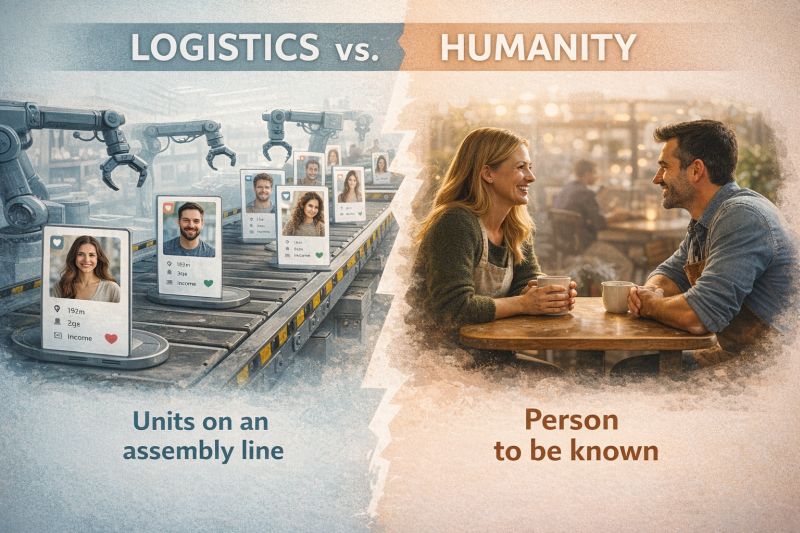
The Tactic: Extreme “filtering”: A 2025 study (Paché) describes this as reducing humans to data points (height, age, income) to manage the “logistics” of desire.
The Sabotage: If any conflict or a red flag appears early on, you close the connection because “if they were the one, it wouldn’t be this hard.”
Instead of looking for a suitable partner, you become a “maximizer” who believes a better “product” is another swipe away. This behavior also serves as a defense mechanism: if no one measures up to your rigid checklist, you stay safe from the risk of a real relationship.
2. Hyper-Individualism (The Autonomy Norm): Western society’s focus on self-reliance, where “needing” someone is seen as weakness or “codependency.”
The Archetype: The feminine version is the “cool girl” (agreeableness); stoic masculinity is the male response. This stoicism leads to stifling emotions and a lack of depth that prevents long-term bonding.
The Sabotage: People suppress their needs or act detached to prove they’re independent, which prevents the closeness required for a secure relationship. Men sabotage the emotional safety needed for a partner to open up, leading to a loop of isolation and apparent emotional unavailability.
Our reliance on technology like TV, computers, smartphones, and video games shields us from the anxiety of rejection. We stay safely isolated behind a screen, mistaking digital outreach for intimacy.
3. The “Marriageability” Script (social capital): Dating becomes a way to check someone’s social status rather than getting to know them. Some people choose partners based on status and earnings rather than love. This “shopping list” approach is rooted in how society has linked marriage to success.
The Archetype: Playing “hard to get”: The player prefers the power they feel from the chase over their target. Once they drop their “mask” of indifference to open intimacy, they often lose interest.
The Archetype: “Dates as job interviews”: In our busy lives, we feel we must vet people for their “social capital” quickly. We see the date as a transaction to check if the other person is worth an investment of our limited time.
The Sabotage: Daters craft a persona that fits a successful archetype (career, hobbies, looks). They hide “messy” parts of their life until they feel they’ve “sold” the other person on the mask. Both parties read from a resume rather than ditching the script to connect.
4. Gendered Emotional Labor Norms (The Stabilizer): The expectation that one partner (historically women) should manage the mood and comfort of the other.
The Archetype: The “angel in the house” (The Victorian ideal of a selfless, nurturing woman who puts everyone’s needs before her own.)
The Sabotage: This triggers the “agreeableness trap” or “self-silencing loop.” People believe that expressing dissatisfaction or setting a boundary means they’re failing as a nurturer.
They stay with a mismatch too long or combust when the emotional work becomes unbearable. They feel they must “keep the peace” and suffer in silence. They eventually burn out and abruptly end the relationship because they never spoke up. Women can mask for physical, not just emotional, safety.
| Broad Societal Norm | The “Mask” or Behavior | The Resulting Sabotage |
| Soulmate Myth | The “Instant Exit” | Immediate dismissal; hyper-filtering. |
| Hyper-Individualism | Stoic Masculinity / The “Cool Girl” | Self-silencing; emotional detachment; lack of co-regulation. |
| Marriageability Script | Playing Hard to Get / The “Marketed Self” | Inauthentic attraction; hiding “messy” parts; fear of being known. |
| Emotional Labor Norms | The “Stabilizer” / The Peacekeeper | The Agreeableness Trap; resentment, sudden burnout, and breakups. |
How Dating Apps Promote Dating Rules and Harmful Social Norms
Dating apps encourage us to project an image to attract a partner, which creates pressure to conform. The endless profiles can keep you swiping; the dopamine-fueled high from “likes” and matches, and the promise of newer ones keeps you hooked.
To stay “marketable,” we practice self-silencing — suppressing our true needs or changing our looks and personalities.
Research on choice overload shows that people who looked at 24 profiles instead of six felt less satisfied after a week and put less effort into their first messages. When the conversation falters, stops, or never starts, the dopamine dissipates.
Dating apps worsen this through tricks to keep you swiping, like showing you when profiles are popular or making matches seem rare. So, it’s not surprising that 78 percent of dating app users say the process exhausts them.
This has led to a surge in AI tools to help users create profiles and write messages.
Forbes reports the main causes of dating app burnout are failure to connect, disappointment, and rejection. What fosters these feelings? Another study breaks it down:
- Productizing: Profiles are treated like products on an assembly line, reduced to data like physical traits and location.
- Swipification: Swiping is a “radical simplification” that reduces the mental and emotional effort required to assess someone.
- The Customer-Corporation Mismatch: Dating app business models need “prolonged user engagement” and constant activity, which often clash with users’ goals of finding a meaningful connection.
- Gender Inequality: Women carry a heavier burden, managing their physical safety and the emotional work of keeping shallow conversations alive.
The dating app burnout causes some to leave the apps; post-pandemic, singles favor emotional maturity and authenticity over traditional status symbols or game-playing. They’re returning to community- or activity-based connections that build trust or authenticity in relationships: ones that feel real without matching an algorithm.
The irony of dating apps is that they often amplify the loneliness they’re designed to cure. We swipe to find a connection, but the lack of clear coding in our profiles means we end up with fatigue instead of a partner.
How Do You Deal With Dating App Fatigue?
The use of AI to write dating profiles or messages raises questions of authenticity, reinforcing why some of us want help showing our real selves.
To fight the fatigue, the Forbes study concludes: “Be authentic in your profile and in how you present yourself to others, ensure the stated intentions and behaviors of a potential date match up and most importantly, take breaks and necessary time away for yourself and your well-being.”
The Signs of Dating App Fatigue
| What It Is / What You Say | What You Mean |
| Information overload: You say, “apps are just exhausting.” | Swiping, mismatches, and the time and energy you spend maintaining profiles and chats drains you. 80 percent of Millennials and 78 percent of Gen X-ers report chronic dating app burnout. |
| Emotional overload: You say, “I’m over the vague-texting and mixed signals.” | Matches go silent or disappear mid-conversation, leaving you confused and resentful. |
| Choice overload: You say, “Dating feels disposable now.” | The illusion there’s always someone better just one swipe away leads to constant comparison. You feel that commitment or genuine effort is pointless because better options seem to exist elsewhere. This paradox creates “analysis paralysis” — you feel stuck. |
| Conversation friction: You say, “Keeping a conversation going is like pulling teeth.” | You get lots of matches or messages, but few real-life meetups or little movement in chats. |
| Interview fatigue: You say, “Stop putting me in interview mode — just be a person.” | Dates feel more like job interviews rather than informal meetings. |
| Identity overload: You say, “They’re just collecting matches for validation.” | You’re frustrated with “performative profiles” — people who look great on paper but are empty inside (sometimes called “reverse catfishing”). You’re tired of “dating code” like vague hobby lines or canned phrases. People perform instead of being themselves. You can feel like you’re walking on eggshells, so you don’t scare them off with your real self. |
| The cause: our insecurities lead to self-silencing for “marketability.” | Research: A cycle of matching powers the “emotional attrition” of dating app burnout. Match/The Kinsey Institute says it leaves over 50 percent of singles feeling drained and pessimistic. Studies show self-silencing — suppressing your needs to stay “marketable” leads to poor outcomes. |
Studies show that when people feel they can be themselves, they have better health and higher self-esteem.
In dating, when options feel limited, people who don’t think they can be authentic often hide who they are. This self-silencing can harm their overall well-being.
“64% of daters want more emotional honesty, with authenticity, emotional vulnerability, and being upfront about feelings ranking as top priorities for 2025-2026.”
Can I Stop Optimizing Myself and Still Be Okay?
One of the best antidotes to the “herd mentality” behind online dating behavior is to think critically.
1. Learn to spot when you’re reacting automatically to social proof — when you become uncertain and default to following others, like endless swiping or creating profiles that seem fake.
Marketing psychologist Dr. Robert Cialdini, author of books like “Influence” and “Presuasion,” suggests asking, “Why am I looking to others? Do I have independent evidence, or am I just uncertain?” Being aware of your behavior helps you change it. It can protect you from following fads or the latest “groupthink” surrounding ads or marketing tactics.
2. Seek better signals: Favor real expertise or personal standards. Trust your gut or your own data over popularity or the crowd.
If you’re willing to do the steps above, the truecasting and clear-coding dating trends might be the answer to dating app burnout. If you’ve overcome the barriers and are connecting with yourself, it’s easier to express your feelings.
How Can I Be Myself on a Date?
One way is to practice truecasting: showing up as you are — losing the sheen behind the screen. “Love me or leave me.”
Clear-coding sounds like it might relate to computer programming or health research, but it refers to being upfront about your intentions. It stops the self-silencing and emotional masking common in dating, and can help us reprogram ourselves and the dating process.
As a form of transparency, 93 percent of singles over 40 cite sexual chemistry — tied to emotional depth — as essential. Coffee Meets Bagel data shows 90 to 93 percent of daters seek serious ties based on emotional fit, not status.
By being authentic on a first date, you’re saying, “I’m valuable enough to show my true self despite the ‘market’ mentality.” The Paché study encourages people to use “authenticity and spontaneity” to resist the consumer-driven logic behind dating apps.
Clear-coding can help you through:
- Slowing the dating process to protect your well-being
- Filtering to distinguish between sharing your values (what’s safe) and sharing personal details (what to share when you feel safe).
- Showing you that rejection isn’t a failure — you’re filtering mismatches before they cause burnout.
Whether it’s really just being honest, clear-coding looks like authentic dating under a new name (a “clear coating”?).
The term might not last or be for everyone. If you’re middle-aged or older, you also could wonder why anyone in your age range wouldn’t be upfront about what they want (assuming they know). Some of us have been dating authentically all along. But others haven’t.
Is Clear-Coding (or Authentic Dating) Right for You?
| Why it might be for you | Why it might not be for you |
|---|---|
| You want a long-term relationship and need time to build mutual understanding. | You have low self-esteem and tend to adapt your personality to please others, which can make showing up authentically feel uncomfortable. |
| You’re tired of dating apps designed to “multiply opportunities” and maximize your time on the platform. | You don’t believe in being honest with people or showing up as you are. |
| You prefer emotional compatibility based on shared values and active listening over superficial metrics. | You see being authentic as part of someone’s personality or character, not a dating philosophy. |
| You want deeper exchanges before meeting offline, where authenticity can thrive, like in hobby-based or activity-based groups: meetups, volunteering, or classes. | You see clearcoding as another buzzword for people to misuse to appear honest when they aren’t. |
| You dislike the tradeoffs: the potential conflict with privacy, safety, or trauma boundaries. Radical honesty sounds great, but it’s easier for some people than others. For instance, if you face discrimination, like people of color or those in the LGBTQ+ community, your safety is crucial. |
Culture and age matter, too. In some cultures, revealing too much personal information is considered rude. For older people, being too open can be harmful — fraudsters have stolen $1.6 billion from them through romance scams.
Despite some risks, clearcoding is more like a safe “on-ramp” to authenticity in relationships where the risks of disclosure don’t outweigh the benefits of connection.
A Clear-Coding or Authentic Dating Manifesto
A declaration of intent for the modern dater.
Traditional dating rules treat people like products. This manifesto considers everyone a person to know and understand.
- I will use radical clarity as a filter. I’m not going to convince people to like me; I’m here to find the person who already values what I bring. That can only happen if they know the real me.
- I will treat my “red flags” as “clear-codes.” The things that make me “too much” for the wrong person are what make me “just right” for the one who fits.
- I will pay attention to my gut feelings. If their profile looks perfect, but I feel a knot in my stomach, I will trust the knot.
- I will stop fearing what people will think when I speak my truth. When I give my opinions, I will stand behind them even if they’re unpopular.
- I will stop self-silencing to keep the peace. Keeping quiet to avoid conflict breeds resentment.
Use this as a starting point for your own manifesto. It doesn’t have to be perfect; it’s about the intent to follow through. Then assess your success, like if you notice fewer “resume dates,” more second dates, and feel greater joy after dates.
To truly apply clear-coding, you first have to overcome common barriers to being yourself while dating.
When Is It Okay to Talk About Yourself on a First Date?
Expert advice on how to practice clearcoding effectively: What to try first, what to avoid to help you stay true to yourself — regardless of societal pressure or dating norms.
Clearcoding isn’t about revealing more; it’s about revealing sooner.
Sharing values and intentions early is meant to filter, not to bond.
Oversharing usually shows up when someone tries to manufacture closeness instead of letting compatibility do the work.
A green flag: Stating a non-negotiable that will immediately turn the wrong people away, such as not wanting casual dating or emotional chaos.
If honesty makes things quieter instead of more intense, it’s probably working.
It’s so tempting to “sell yourself” in a positive, unrealistic way to someone you’ve just met. And sadly, you can’t maintain a “false image” for long. It’s not a healthy way to treat yourself or the other person.
What I’ve learned in my over 16 years of dating and relationship coaching is both men and women say the sexiest traits they’re drawn to are self confidence and someone being their most authentic self.
A green flag: Clearly, openly and nicely sharing a few things that make you happy in your life that include other people will help the other person see how they could fit in your life in a positive way.
Clearcoding is stating your reality and what you’re looking for versus oversharing, which dumps unprocessed pain onto someone else. The difference?
Clearcoding invites someone in to see if you’re compatible; trauma dumping makes the other person your therapist. If you’re sharing something and secretly hoping they’ll fix it, validate it, or rescue you from it, that’s not authentic, that’s outsourcing your healing.
A green flag: Someone saying “I’ve done therapy and learned I need direct communication because I shut down when there’s passive aggression” is gold. It shows self-awareness, accountability, and tells you exactly how to relate to them.
One of the things people do too much in dating is assume. That is to say, if someone tells you family is very important to them as a value, that can mean different things to different people, as well as show up differently. One thing you should have in your first date arsenal is stories that you can naturally work into conversation that demonstrate your values.
A green flag: Asking “tell me more” or “What does that look like for you?” will prompt your date to share clear examples of how what is important to them shows up in their lives.
I believe sharing something you fear or worry about is a wonderful way to show transparency, but using the other person as a free therapist is never a good idea.
I’m one of those dating coaches (and a long-time single person) who advocates for full disclosure in a discerning, well-paced way.
Sharing one’s story is a deeply human way to bond on a first date. Healthy clearcoding means being upfront, and not hiding your pain, lived experience, or intentions — the things that give a person character and soul.
Talking about your divorce, recent breakup, or frustration with dating apps, are all universally experienced things and can be discussed without TMI or trauma dumping.
The dating world is so transactional, why not just get right to the truth of each other and not waste time?
Clearcoding is about sharing what guides your choices, like your values, what you’re looking for, and how you show up in relationships, without delving into unresolved pain or personal history.
I tell clients to aim for context, not confession. You’re offering insight into who you are today, not unpacking every experience that shaped you.
A green flag: When someone says something like, “I’m looking for a relationship that feels calm and real”. It’s simple, but it tells you they’re grounded and intentional, without the pressure or performance.
What to Skip
❌ Overthinking. Don’t try to “think” your way out of a bad feeling. If your gut says “no,” you don’t need a list of reasons to justify it.
❌ Forced vulnerability. Don’t share your deepest traumas on a first date to “be authentic.” Being honest doesn’t mean being an open book. Wait until you both feel safe with each other.
❌ The “Spark” Chase. Experts like Helen Fisher suggest “instant chemistry” is often just your nervous system reacting. Look for comfort and kindness first. They help you spot deceptiveness, a key trait of “dark triad” or cluster-B personality disorders like sociopathy and narcissistic personality disorder. Comfort, safety, and kindness build the foundation for authenticity.
How Do I Reconnect With Myself?
This blog is based on three questions from the second half of the 12-question multiple-choice “Am I Dating in Disguise?” quiz.
Take the quiz to find out if you’ve overcome the barriers to authentic dating and are connecting with yourself. The second half shows whether you’re avoiding vulnerability.
Note: This blog is for informational purposes only. It’s no substitute for a professional diagnosis. If you find it hard to be vulnerable or to express yourself, seek help from a licensed mental health professional.
Dating App Fatigue and Authenticity in Relationships: Frequently Asked Questions
Take small steps. Start by expressing an opinion about something without low stakes, like “I love rainy days” or “I don’t like the vibe of this restaurant.” As opportunities arise, share more of your thoughts and feelings, even if it feels awkward at first. The right person will appreciate your honesty. If not, they’re probably not a match.
Be direct about who you seek early on. In messages, try: “I’m looking for something serious” or “I prefer to take things slow and get to know someone first.”
On a first date, share specific interests instead of giving vague answers. If they ask what you do for fun, skip “I like to travel and try new restaurants” and say something like “I’m rebuilding a vintage motorcycle” or “I volunteer at the animal shelter on weekends.”
Take a break from dating apps for a few weeks and see how you feel. If you feel relief, it’s probably app fatigue. But if you still feel drained, talk to your medical provider.
If you think you’re the problem, ask people you know and trust for honest, constructive feedback.
It helps you filter people who want commitment and attracts those with similar goals.
You can still be authentic about your interests, sense of humor, and boundaries without leading anyone on. Honesty about your intentions is respectful, whether you’re looking for three months or 30 years.
Key Takeaways
- Dating app fatigue is real. Over 78 percent of users report exhaustion from dating apps, which turn people into products and reward endless engagement.
- Self-silencing erodes your well-being. It could lead to poor relationship outcomes and harm your mental health. Research shows that when people feel they can be authentic, they have better health and higher self-esteem.
- Following social norms might sabotage your dating life. Four common beliefs: the soulmate myth, hyper-individualism, the marriageability script, and gendered emotional labor can lead to patterns that prevent genuine connection.
- Clearcoding is radical honesty with boundaries. It’s being upfront about your intentions and values without oversharing personal details before you feel safe.
Take action:
- Spot when you’re self-silencing and practice expressing small opinions
- Take breaks from dating apps when you feel drained
- Use authenticity to filter mismatches early rather than performing for approval
- Trust your gut over the “spark” — prefer comfort and kindness to instant chemistry
Being honest helps you move to exclusivity faster based on traits like shared values and builds trust through open discussions — without games, masks, or ghosting. You can spend less time checking if someone is a fit.
Clear-coding and truecasting favor quality over quantity — scaring off mismatches. Authentic connections feel more like teamwork than a negotiation or a relationship built on a pretense. For those who know what they want, it makes dating less like a job interview and more like two people connecting.

She invites singles dating after 30 to join her on the journey to love, one that fosters self-acceptance and an awakening to the joys of life. Discover how dating with intent through expert advice and stories grounded in experience can help you find a match.
For more guidance on authenticity in relationships, watch Michelle’s latest YouTube videos
@MyJourneytoLove-y4e.
- How Being Authentic When Dating Helps You Avoid Manipulation - August 28, 2026
- Relationship Baggage: What to Consider When Dating Someone With a Bad Past - July 24, 2026
- Dating Someone With Relationship Stability Risks - June 24, 2026
